
The Better Cooperate project has launched an online Knowledge Repository, bringing together a rich mix of resources for anyone interested in social entrepreneurship and the social economy. Visitors can explore the collection at: https://better-cooperate.online/knowledge-repository/

The repository gathers content in several categories — guides and manuals, e-learning courses, case studies, infographics, podcasts, videos, quizzes, board and online games, and business development tools such as Business Model Canvas resources. Materials come from partners and organizations across Europe, so users will find content in multiple languages, including Polish, Serbian, and English, reflecting the project’s cross-border scope.

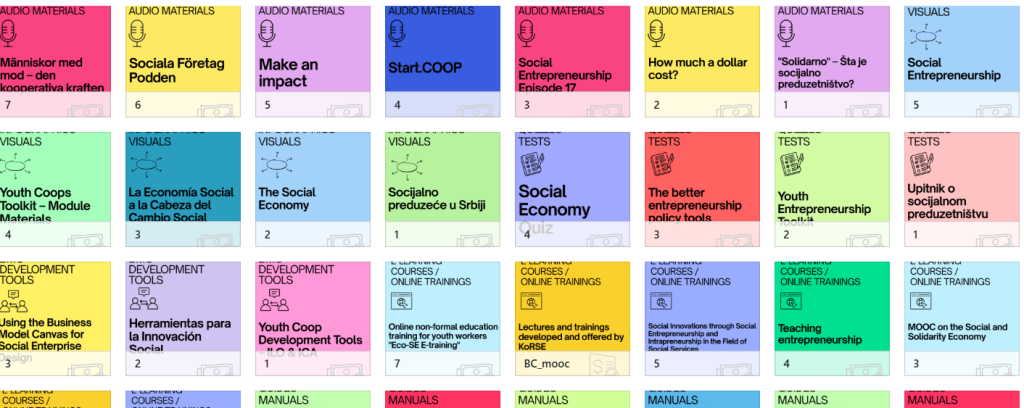
To make browsing easier, each category page features colorful, eye-catching graphics that help visitors quickly identify the type of material and jump straight to what interests them, whether that’s a quick infographic, a full MOOC course, or a practical guide for founding a social enterprise. A special icons also inform wheter the resourse is free of charge (more than 80% of all repository) or paid.

Whether you’re an NGO practitioner, a student, or simply curious about how business and social impact intersect, the Knowledge Repository offers a convenient, well-organized starting point — and best of all, it’s completely free to access.
Leave a Reply

Cookies Policy

Files (so-called 'cookies') are computer data, particularly text files, that are stored on the end device of the user of the service and are intended for using the website of the service.

Cookies usually contain the name of the website from which they originate, the time of storing them on the end device, and a unique number. Cookies are used for:

  • Applying the content of the service's websites to user preferences and optimizing the use of the websites; in particular, these files allow recognizing the device/user of the service and displaying the website accordingly, tailored to individual needs.
  • Creating statistics that help understand how users of the service use the websites, enabling the improvement of their structure and content.
  • Within the service, 'persistent' cookies are used. 'Persistent' cookies are stored on the end user's device for a specified period, as specified in the parameters of the cookie files or until they are deleted by the user.

The following types of cookies are created within the service:

  • 'Essential' cookies, enabling the use of services available within the service (e.g., authentication cookies used for services requiring authentication within the service).
  • 'Performance' cookies, enabling the collection of information on how users use the service's websites.

In many cases, software used for browsing websites (web browser) allows the transmission of cookie files to the user's end device by default. Users of the service can change cookie settings at any time. These settings can be changed, in particular, to block the automatic handling of cookie files in the internet browser settings.

Detailed information on the possibilities and methods of handling cookie files is available in the software settings (internet browser).