
Space Misfits – Build a Future Worth Fighting For
Publication date: 2025-06-10
We’re currently working on a… game! Yeah! A game! And not just any game-a space adventure packed with pirate energy, moral dilemmas, and… social economy mechanics?! Yep. We said it. Forget everything you know about pirates. In Space Misfits, you’re not plundering gold-you’re chasing hope. This is a single-player strategy adventure where you command a […]
3rd TMP: Goteborg

Publication date: 2025-02-28
On February 12-13th in Goteborg, Sweden the third transnational partners’ meeting of the project Better Cooperate. Education through and to the values of the social economy as a way to reinforce the society took place. The meeting was attended by 10 participants from 6 partner countries. The main goal of the meeting was to evaluate […]
Veil of ignorance: a game of social inequality

Publication date: 2025-01-30
“Veil of ignorance” game is an interactive exercise designed to make participants aware of decision-making mechanisms in the context of social justice. It is based on John Rawls’ concept that fair decisions should be made without awareness of one’s social position. Duration: 20 minutes Preparation:Divide participants into several smaller groups.Distribute the veil of ignorance cards […]
“Better to Work Together!” – Comprehensive Program on Social Entrepreneurship

Publication date: 2025-01-22
In the face of today’s pressing challenges—social inequality, climate change, digital transformation, and an aging population—collaboration, solidarity, and innovative thinking are more vital than ever. “Better to Work Together!” and “Better Cooperate!!” are two complementary resources that provide practical tools and knowledge to address these global issues through social entrepreneurship. Two pillars of Social Entrepreneurship […]
Social Entrepreneurship Lessons Scenarios
Publication date: 2025-01-03
The present collection contains 18 scenarios at various levels of difficulty (basic, intermediate, advanced). The structure of the material corresponds to, complements and extends the Social Entrepreneurship Education Programme. The scenarios thus relate to modules related to: 1) Social economics and the primacy of value over profit 2) Social economics and inequality; 3) Social economics […]
Social Entreprenurship Educational Programme
Publication date: 2025-01-03
Welcome to the “Better Cooperate” handbook, an extensive manual created to give young people the fundamental information and abilities required to succeed in the social economy. The six meticulously developed training modules of the “Better Cooperate” project—a revolutionary effort that aims to equip the future generation to actively contribute to social and economic development—have been […]
Educational programme tests in Potenza

Publication date: 2024-11-18
Exeo Lab Srl tested the social entrepreneurship education programme developed. Here’s what the sessions looked like: The first session was held stationary at GoDesk in Potenza and was about social entrepreneurship and local development. Participants exchanged experiences, identifying local challenges and opportunities in the social economy sector. The session was full of interactive activities, such […]
Educational programme tests in Subotica

Publication date: 2024-11-04
Otvoreni univerzitet Subotica together with a group of 28 male and female students from the Secondary School of Economics ‘Bosa Milićević’ in Subotica tested an innovative educational programme aimed at developing social entrepreneurship among young people. The tests have gathered key findings and adapted the materials to meet the needs of different audiences. This is […]
Social Entrepreneurship Training
Publication date: 2024-10-20
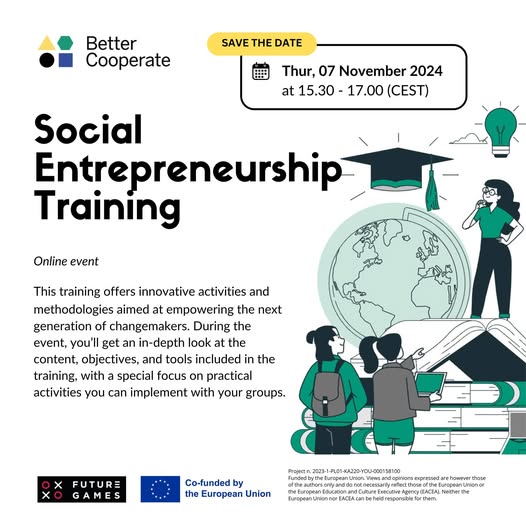
On behalf of our Swedish partners in the #BetterCooperate project, we invite you to participate in an online training that offers innovative activities and methodologies to empower the next generation of changemakers. During the event, you’ll get an in-depth look at the content, objectives, and tools included in the training, with a special focus on […]
Back to the basics – training in Subotica

Publication date: 2024-09-20
The first training and learning activity is behind us: from 9th to 13th of September project team together with invited trainers took part in the workshops in Subotica, Serbia. The workshops were hosted by project partner – Open University of Subotica. Theme of the training was “Back to basics” understood as the way to discuss […]